
Your child has great ideas but struggles to get them on paper. Here's why.
Written output is more than handwriting; it is a communication tool. We use it to remind ourselves what we need at the store, to make plans with friends, to communicate our ideas at work. For a child though, written output is often a large component of how their academic understanding is graded at school.
If we break down the task of writing a short story about a monster in the house, we have to generate the plot line, build out the characters, organize our ideas, apply what we know about the structure of a story, form complete sentences, remember grammar rules, spelling and then form all the letters needed to make the words, space them properly, size the letters and place them on the line, and have the endurance to write all the letters. That is a lot!
An analogy I often use with adults, is the feeling of being stuck and frustrated in traffic. All those cars on the road, the construction, the things slowing you down from getting to your destination, are all the components of writing the monster story. When the road (our brain) is overloaded with so many tasks, we often compromise to get through it. That could look like writing less, shorter sentences with fewer details, large or messy writing, or avoiding the task altogether. If we can take some of the cars (cognitive and motor skills) off the road by increasing confidence and skill mastery, then we can reach our destination faster and happier.
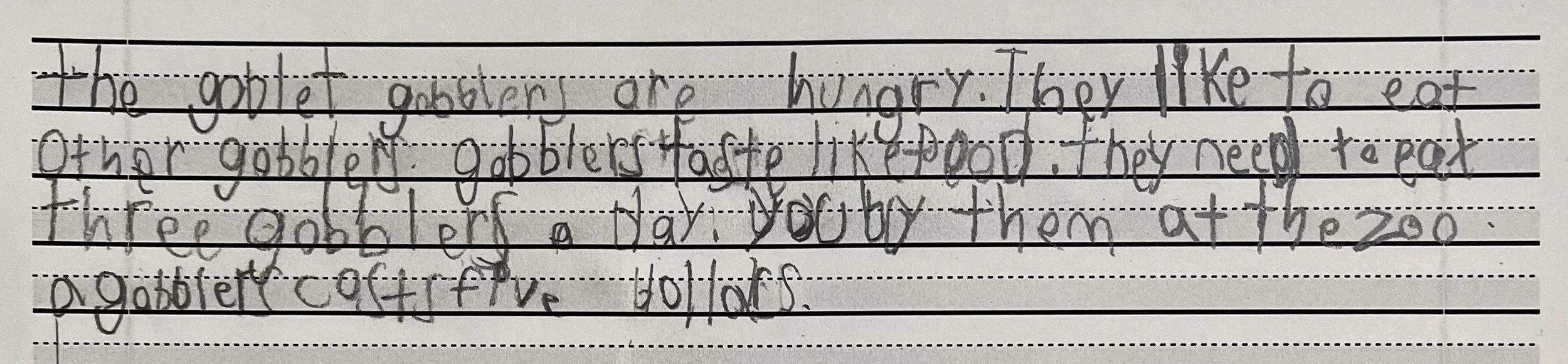
Here is an example of the impact of increasing the cognitive load and handwriting.Adapted writing paper with visual cues support letter sizing and placement, the same paper was used in both samples.
In the above sample, the child came up the sentence (idea generation), and I spelled all the words. The writing is legible, consistently sized, and sits on the baseline.

Now I had the child spell the words, all other task components were the same. By just adding this one additional layer, while the writing is still legible, you can see the letters are not as consistently sized, not as oriented to the baseline, there are some capital letters, and the spacing between words is slightly less. They initially made up a longer sentence but asked to write this shorter one. This sentence took longer to write as expected.
In this sample, the child came up with the sentence (idea generation) and had to spell the words themselves. By just adding this one additional layer, while the writing is still legible, you can see the letters are not as consistently sized, not as oriented to the baseline, there are some capital letters, and the spacing between words is slightly less. This sentence took longer to write as expected.
I point this out because it shows the impact of having one more task added on the efficiency of writing. When this happens, children often develop low confidence in their handwriting skills and as a result they either avoid the task or produce very little despite verbally producing great ideas and a strong understanding of the concepts. These children are at risk of having a mismatch between how their abilities are perceived and their actual potential.
Working on mastering letter formations, visual-motor skills for organization on the page through fun allows for repetition and mastery. As the letter formation and placement becomes more automatic, it reduces the cognitive load and allows resources to support other areas (idea generation, organization). Imagine if you had to think about how to form and place each letter, you would find writing frustrating too! When children have the tools to complete the tasks asked of them, they are more emotionally regulated which allows them to learn and show their best skills.
If this sounds familiar, exploring an occupational therapy assessment can help clarify where your child's strengths and challenges lie. Getting support early to build children’s written output skills is important for their overall development and self-confidence.
References:
Kim, Young-Suk Grace, et al. "Writing Instruction Improves Students' Writing Skills Differentially Depending on Focal Instruction and Children: A Meta-Analysis for Primary Grade Students." Educational Research Review, vol. 34, 2021, article 100408.
López-Escribano, Carmen, et al. "Promoting Handwriting Fluency for Preschool and Elementary-Age Students: Meta-Analysis and Meta-Synthesis of Research from 2000 to 2020." Frontiers in Psychology, vol. 13, 2022, article 841573.
Ruffini, Claudia, et al. "The Relationship between Executive Functions and Writing in Children: A Systematic Review." Child Neuropsychology, vol. 30, no. 1, 2024, pp. 105–63.